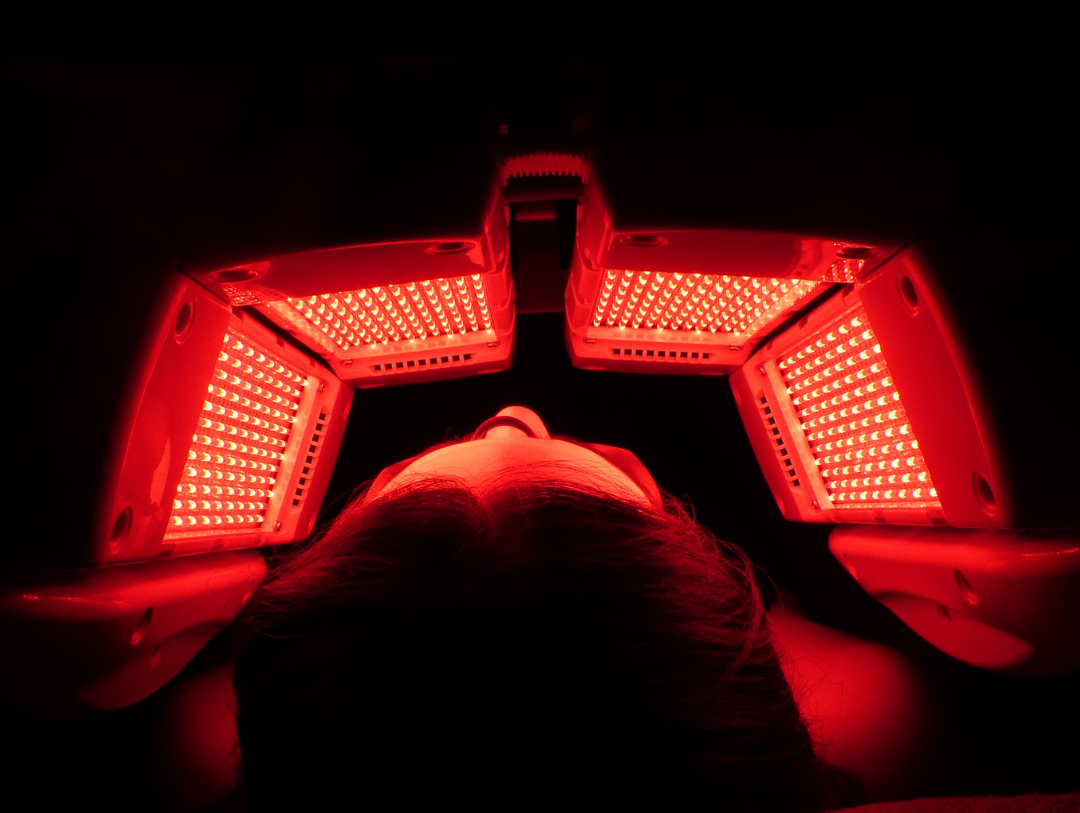

Both red (around 630nm wavelength) and near infrared (around 830nm wavelength) light have been widely researched for the action on capillary health and integrity. Of course, existing broken capillaries cannot be repaired but red / infrared LED treatment will help prevent further capillary damage. By helping break down the by-products of leaked blood from broken capillaries, red/infrared light can also help with the dark pigmentation that occurs in those cases…
Red light vs infrared light therapy: what is best?
Red light therapy (wavelengths of 620 to 750 nm) and near infrared light therapy (wavelengths of 800 to 2,500 nm) has become very popular the last few years for both aesthetic (anti-ageing, acne, hyperpigmentation, skin rejuvenation etc) and wellness (pain relief, sports injuries, back pain, seasonal affective disorder, burns, wound healing etc) applications. Many people wonder what is the main difference between red light and near infrared (NIR) light therapy and the answer is quite simple, as we will see below...
Red/infrared light therapy vs green, yellow and orange for skin rejuvenation: what's best?
A science paper published in 2014 explored the effectiveness of photobiomodulation (PBM) using novel polychromatic light sources vs red light for skin rejuvenation. The study investigates how non-thermal red and infrared light can improve skin appearance and stimulate collagen production, offering a gentler and more effective alternative to traditional skin rejuvenation methods like laser resurfacing or intense pulsed light (IPL). The study also compares red/infrared light therapy versus green, yellow and orange light therapy, in terms of skin rejuvenation (fine lines, wrinkles, skin roughness and skin collagen content)…
Can I have infrared / red light therapy treatment with makeup on?
Red and infrared light therapy (phototherapy) is very popular as an anti-ageing facial treatment, as it is generally very safe and instantly effective. The general rule is that makeup must be removed before phototherapy treatment. This is because makeup quite often contains ingredients which aim to reflect light back from the face, in order to create an effect of “radiance” and light on the skin. However, if they have a treatment during lunchtime, many women find it a hassle to remove...
An LED mask is typically 6 to 20 times weaker than the best professional LED device
LED light therapy (phototherapy / photobiomodulation) is used to treat a variety of aesthetic and health concerns, most commonly skin ageing, skin wounds/burning, diabetic wounds, psoriasis, hyperpigmentation, acne, seasonal affective disorder, sports injuries and back pain, among others - and to enhance the effectiveness of other treatments, such as radiofrequency or ultrasound. Red and infrared light wavelengths are used for all the above concerns, except from blue wavelength, which is used for acne and psoriasis. LED devices come in the shape of masks, panels and dome/canopy style...
Laser and red/infrared LED light therapy vs radiofrequency and cavitation for skin tightening and cellulite
Which is better for body skin tightening and cellulite: laser or radio frequency? Absolutely NOT laser. Laser is way too superficial and also pointless for skin tightening or cellulite. There are two types of lasers: strong, ablative, lasers aim to burn the surface of the skin to stimulate new epidermal growth. Cellulite, however, is found at the deepest layer of the skin (hypodermis), not the most superficial (epidermis), so ablative lasers do not work for cellulite at all…
Is it better to have red light therapy in the morning or later in the day?
You’ve decided to try red/infrared light therapy at our clinic, and now you’re wondering whether it’s better to schedule your session in the morning or the afternoon. The choice might feel significant, but the truth is, it largely depends on your personal needs and routine. Red/infrared light therapy offers a range of benefits, and understanding how it fits into your day can help you make the most of it. Here’s what you need to know to decide…
IPL vs LED red light therapy for facial skin redness
Superficial facial vascular lesions (facial redness, thread/spider veins) can be an aesthetic problem as well as a symptom of different skin diseases. Risk factors include Fitzpatrick skin types I, II and III, significant sun exposure, rosacea, alcohol consumption and smoking. Facial spider veins and related facial vascular lesions are treated with laser, IPL and LED phototherapy treatments. The first two (laser and IPL) are generally more effective but also can cause side effects, such pain, erythema/redness and less often oedema, blistering, hematoma, crusting, hyperpigmentation, scarring, keloid formation and infection…
Infrared light therapy for achilles tendinopathy
The most common treatment regime for achilles tendon injury involves eccentric exercises to effect fibre remodelling. However, low level light therapy (LED or laser), usually in the infrared range for improved penetration, is also used for soft tissue / sports injuries, such as tendinopathies, always in combination with exercise. The randomized controlled trial listed below investigated the clinical effectiveness of an eccentric exercise regime for achilles tendinopathy and evaluated the additional benefits of photobiomodulation (low level light therapy, LLLT) as an adjunct treatment. The study challenged the necessity of the intensive Alfredson protocol…
Advanced LED light therapy treatments for back acne in London
Advanced red light therapy treatments in London
Advanced blue, infrared and red light therapy treatments in London for anti-ageing, skin rejuvenation, acne, wound healing, skin firming, back pain, sports injuries, stress relief and deep relaxation at LipoTherapeia, in the heart of London. Two decades of experience, honest advice, personalised treatment, caring service. Book now!
Does LED light help with nasolabial folds?
Red and infrared light therapy with an LED device can indeed help with anti-ageing, skin healing and rejuvenation, giving skin a healthy glow and helping prevent skin laxity and fine lines and light wrinkles. However, its effect is not strong enough to reduce nasolabial folds (smile lines), especially deep ones that have formed over…
Does infrared light really tighten skin?
Infrared light penetrates more than red light and can better reach the dermis where fibroblasts (collagen and elastin producing cells) and collagen structures are found. High-power LED phototherapy in the near infrared wavelength boosts mitochondrial function via the stimulation of cytochrome C oxidase enzyme. Improved mitochondrial function means better fibroblast function and increased collagen and elastin synthesis, meaning firmer skin. No other procedure is known to have this effect on mitochondrial function - only red light at around 630nm and infrared light at around 830nm. However, this effect is subtle and appears gradually and slowly, so infrared…
How long to see results from LED light therapy?
It all depends on the protocols and the LED device you are using. With correct protocols and a proper, high-end LED canopy device results can appear immediately after the end of the session and quite often are impressive. With multiple sessions results are cumulative and long-lasting. On the other hand, with a home-use LED mask (even the high-end ones) results are subtle and take…
Is yellow LED any good?
LED light therapy has gained huge popularity in the last few years, with a plethora of machines, from high-end and super effective to low-end and practically useless and each of them employing different intensities and wavelengths. Blue, red, near infrared light, ~415nm, ~630nm and ~830nm, respectively, are proven to work by literally thousands of studies. However, for the yellow wavelengths (570-590nm) there is only a handful of studies…
Does LED help with dark spots?
Dark spots and hyperpigmentation in general are prime indications for the use of red and near-infrared light therapy. Red and near-infrared light, either from an LED or low-level laser light source exerts an anti-inflammatory and a skin metabolism-boosting effect (due to stimulation of mitochondria), which results in hyperpigmentation reduction, over several sessions…
Will one session of red light therapy help?
For some immediate skin rejuvenation, pain reduction in musculoskeletal injuries and even improvement with acne appearance, even one session with a high-power LED device (i.e. ~120mW/cm2) can actually make a difference, and we see it every day at the clinic. Facial skin brightens immediately with a healthy glow and “angry” acne calms down and looks much milder…
Is red light therapy real or fake?
Red light therapy, as well as infrared and blue light therapy, is becoming ever more popular. With this popularity hundreds of LED red light therapy devices have appeared on the market and with all the miracle claims, the internet, tiktok and instagram misinformation and the confusion, a lot of people understandably question whether red light therapy is legit or not. To put it very shortly, properly applied red light therapy - as well as blue and infrared light therapy - are real…
How often should I do LED on my face?
How often you can have LED treatment on your face - or any other body area - depends on the device’s light intensity. The higher the intensity the less often you should have treatment and vice versa. As with everything else in life a little more is good but a lot more is usually bad - and that applies to LED treatment too. LED treatment may be almost side-effect free but…
Why are good LED masks so expensive?
And this is a common question we hear: “Why good LED masks (and professional LED devices) so expensive?” Well the answer is: “they are not”. In the West we are addicted to cheap imported goods and so we believe everything should be dirt cheap. And indeed, many LED masks are dirt cheap but, as many people understand, they are of poor quality, while the higher quality devices are considered “expensive”. A good home-use LED mask (or even professional LED device for use at clinics) must use high quality LED bulbs that provide what it says on the tin: red or infrared light of a specific frequency and specific intensity, constantly throughout the treatment…